Lesson 1
Preparing to Work with the Cards
Questions and Time Frames
Significators
Why Lenormand?
Well, clich├йd as it may sound, because the cards are beautifulтАФand they speak to us.
Recently, a man on Telegram told me that he had bought a deck at a student caf├й opposite the university in Wroc┼Вaw, Poland. Not because he had studied Lenormand or was looking for anything in particular. He was simply drawn to it.
And then the search beginsтАФfor information, meanings, history, and sources.
Sometimes it all starts with a sense of attraction, and then comes the journey of discovery. Curiosity comes first. Then knowledge. And somewhere between the two, a connection with the cards is born.
Something similar happened to me.
I bought my first deck many years ago through a Facebook group. It turned out to be a replica. I later learned that similar decks are widely ordered from AliExpress and then resold.
One thing is certain: once you get to know the Lenormand cards, you fall in love with them. And you rarely stop at just one deck. Another always comes along.
But don't be fooledтАФthese are not just pretty pictures.
They hold an enormous amount of information. Symbolism, numerology, a little astrology, and, of course, playing cards all intertwine within them.
And that is precisely where it all beginsтАФwith playing cards.
Why Are Playing Cards Important?
Every card in the Lenormand deck corresponds to a particular card in a standard playing-card deck.
This is no coincidence. Playing cards carry an additional layer of information that can help us better understand the energy of an individual card or an entire spread.
Each suit is associated with an element:
тЩе Hearts тАФ the element of Water
Like Cups in Tarot, they are associated with emotions, feelings, intuition, and relationships.
тЩж Diamonds тАФ the element of Earth
Like Pentacles in Tarot, they point to the material world, finances, work, and practical matters.
тЩг Clubs тАФ the element of Fire
They carry the energy of action, activity, initiative, ambition, and growth. Just like Wands in Tarot.
тЩа Spades тАФ the element of Air
They are associated with thought, communication, the exchange of information, ideas, and analysis. Just like Swords in Tarot.
Why Does This Matter?
When one particular suit dominates a spread, it can give us another clue about the nature of the situation.
A predominance of Hearts indicates strong emotions, sensitivity, and a personal investment in what is happening.
A predominance of Diamonds points to material matters, work, finances, property, and security.
A predominance of Clubs suggests a need for action, activity, initiative, and moving forward.
A predominance of Spades places the emphasis on communication, conversations, learning, the exchange of information, and thought processes.
It is important to remember that the playing-card correspondence is an additional layer of information. It does not change the core meaning of a Lenormand card; it adds to it and gives it another shade of meaning.
First, we read the Lenormand card itself. Then we may draw on its corresponding playing card to add another nuance to the interpretation.
Of course, this is only a very superficial introduction to the subject.
Playing cards are an extensive system in their own right, with their own history, symbolism, and methods of interpretation.
For the purposes of our course, it is enough to know the basic correspondences and how they can add another layer of information to our spreads.
Playing-card cartomancy itself belongs in an entirely different course. ЁЯЩВ
We will study the cards in detail and look at how they reflect different areas of our lives.
ButтАж so that you can begin working with your deck from the very first day, I will give you keywords for every card. They will provide a foundation to build on, allowing you to make daily interpretations.
I recommend keeping a journal.
Make drawing one card part of your morning ritualтАФalong with your coffee. Write it down and follow how your day unfolds, noticing how closely the events match the card you drew.
Why Is a Journal Important?
No matter how many keywords you learn for each card, you will be surprised at how many different ways it can show up in real life.
By keeping a journal, you gradually build your own personal databaseтАФyour very own grimoire. ЁЯШК
This is where theory begins to come alive and turns into personal experience, rather than remaining a collection of memorised meanings.
Every card has certain essential features: a symbol, a number, and (in most decks) an inset playing card.
Over time, you will discover how important each card's number is in the Lenormand system. It is not merely a position in a sequence; it carries additional structural significance in interpretations and card combinations.
As you learn, try to remember the number of every card. This will make working with spreads and relationships between cards much easier.
Keywords for All 36 Cards:
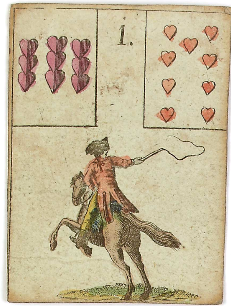
Rider
news, message, visitor, phone call, delivery, new information, movement, transport, speed, new ideas, young man
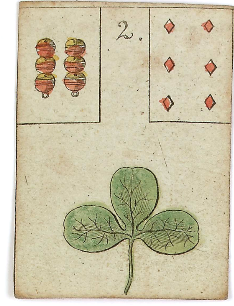
Clover
luck, chance, opportunity, hope, small gain, reward, optimism, gambling
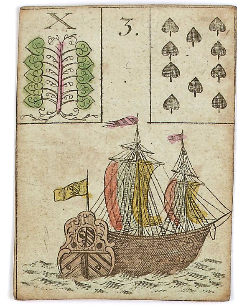
Ship
travel, journey, transport, long-distance movement, trade, major projects, change of surroundings, expansion, a distant destination, separation
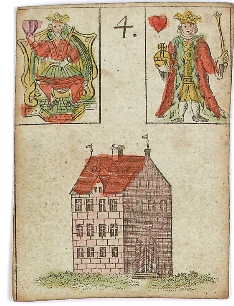
House
home, family, stability, security, parents, traditions, real estate, protection, belonging
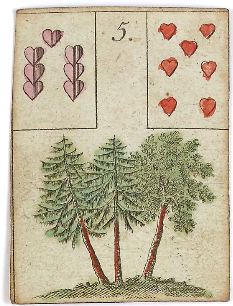
Tree
health, vitality, growth, stability, patience, the long term, roots, the past, resilience
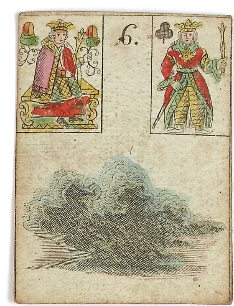
Clouds
doubt, uncertainty, confusion, hesitation, concealment, unpredictability, temporary crisis, mental fog
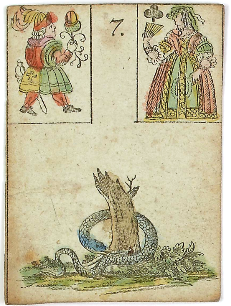
Snake
cunning, intrigue, competition, deception, temptation, duplicity, envy, but also wisdom, deep knowledge, esotericism, occult subjects, medicine
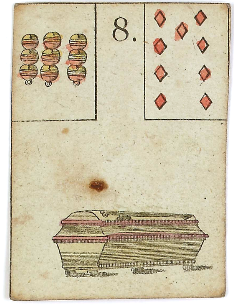
Coffin
ending, loss, separation, stagnation, pain, transformation, the closing of a cycle, passivity
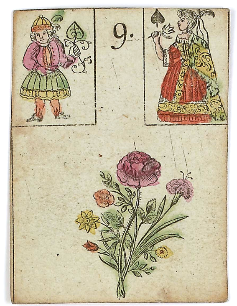
Bouquet
joy, gift, meeting, happiness, pleasure, celebration, pleasant company, beauty, harmony
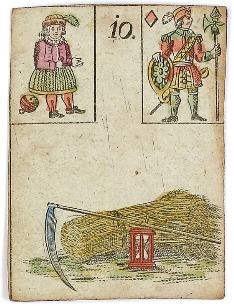
Scythe
sudden change, ending, severing, conflict, danger, injury, aggression, swift and decisive action
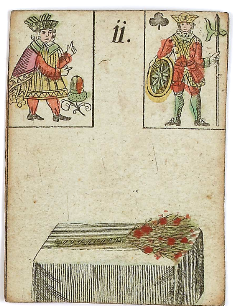
Whip and Broom
conflict, quarrels, aggression, tension, recurring arguments, punishment, clearing things out, as well as sexual energy, sport
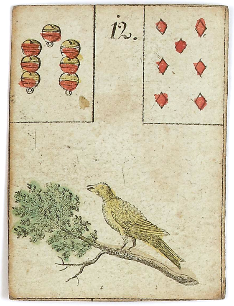
Birds / Owls
conversations, communication, negotiations, gossip, anxiety, nervousness, rumours, social contacts, mental activity, sometimes private conversations
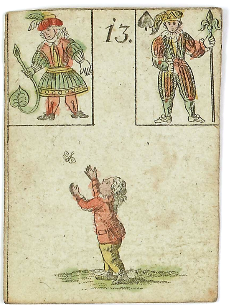
Child
beginning, fresh start, innocence, naivety, trust, energy, learning, potential, new opportunity, pregnancy, dependence, sometimes immaturity
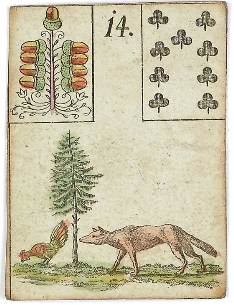
Fox
cunning, deception, intrigue, hidden intentions, manipulation, slyness, temptation, but also work, skill, strategic thinking
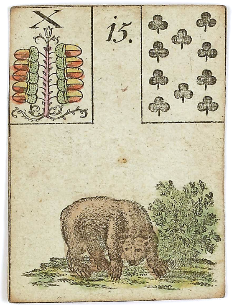
Bear
strength, power, authority, protection, patronage, stability, financial support, maturity, influence
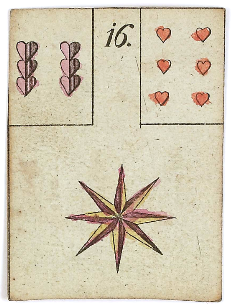
Stars
hope, inspiration, dreams, intuition, clarity, spirituality, esotericism, astrology, progress, direction
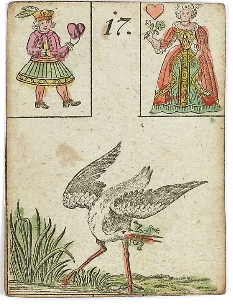
Stork
change, movement, transformation, travel, relocation, news, birth, development, cyclical changes
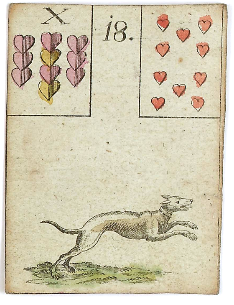
Dog
loyalty, friendship, support, trust, devotion, protection, honesty, reliable person, unconditional help
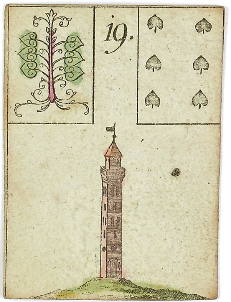
Tower
protection, boundaries, structure, authority, institutions, administration, solitude, isolation, independence, school, bank, official organisations
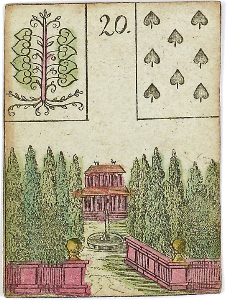
Garden
society, social contacts, groups, events, audience, public opinion, reputation, gatherings, festivals, cultural events
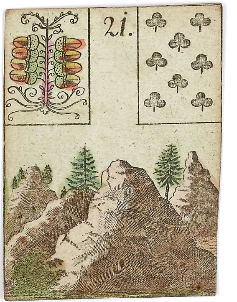
Mountain
obstacle, blockage, difficulty, delay, test, burden, immobility, barrier, need for patience
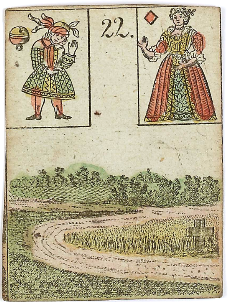
Crossroads
choice, direction, alternative, decisions, indecision, separation, new opportunities, different options
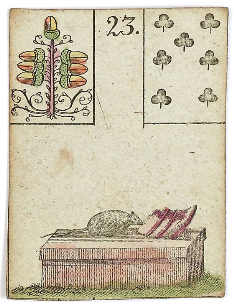
Mice
loss, wear and tear, anxiety, stress, theft, energy drain, deterioration, gradual destruction, team
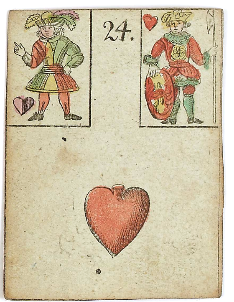
Heart
love, affection, fondness, relationships, emotions, tenderness, care, romance
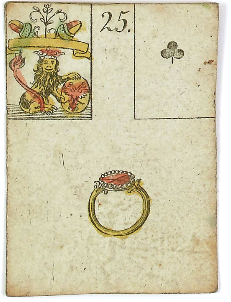
Ring
bond, union, contract, partnership, marriage, promise, commitment, cycle, repetition, cooperation, being stuck in a loop
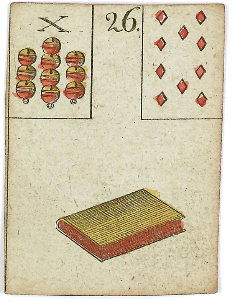
Book
knowledge, secret, information, studying, research, education, course, the unknown, hidden information, a deck of cards
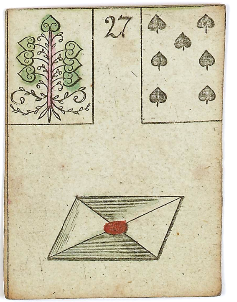
Letter
message, news, communication, document, contract, official information, certificate, notification
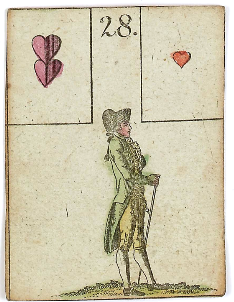
Man
male figure, activity, action, strength, achievement, courage, brother, querent (male)
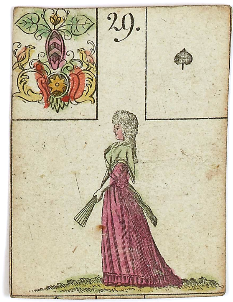
Woman
female figure, intuition, sensitivity, empathy, receptivity, querent (female)
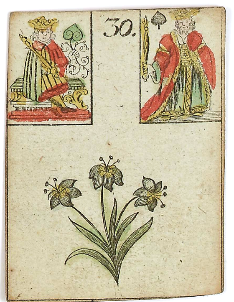
Lilies
harmony, peace, nobility, maturity, authority, honour, morality, purity, intimacy, sexuality, experience, calm
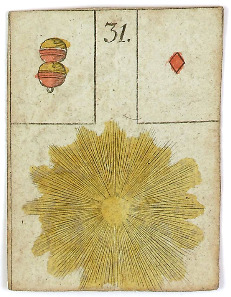
Sun
luck, success, joy, victory, recognition, respect, optimism, energy, progress, creativity, satisfaction, generosity, great opportunities
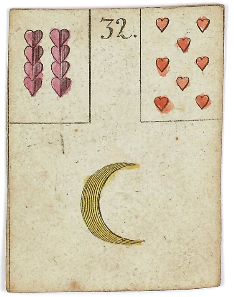
Moon
emotions, intuition, subconscious, instincts, sensitivity, femininity, romance, mysticism, cycles, mood swings, talents, esotericism, imagination
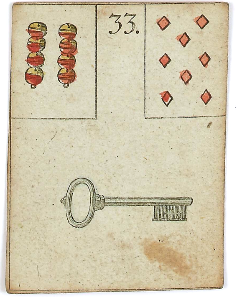
Key
solution, answer, way out, luck, resolution, discovery, access, important tool, clarity
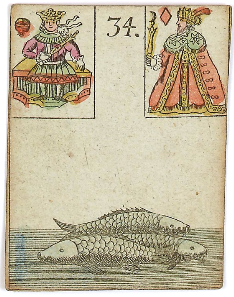
Fish
money, abundance, resources, material gain, trade, shopping, spirituality, intuition, inheritance, flow
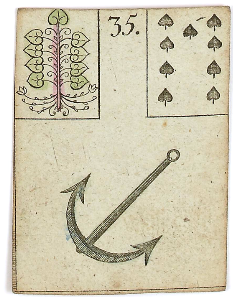
Anchor
stability, security, constancy, work, profession, reliability, being fixed in place, the long term, restrictions
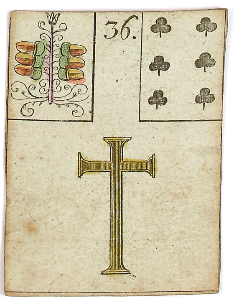
Cross
fate, trial, burden, suffering, karma, responsibility, sacrifice, difficulties, ending, inevitability
Practice
The most important part of learning is practice.
The more you read, the more you see.
The second important thing is not to be afraid of making mistakes. Fear of getting it wrong can be paralysing, and it often prevents us from taking the first step.
Mistakes are an inevitable part of learning, growth, and action. What matters is not avoiding them at all costs, but learning from them and moving forward with the experience we have gained.
Nobody becomes good at something on their first attempt. Every reading, every spread, and every imperfect interpretation is a step towards a deeper understanding of the cards.
тАЬOnly those who do nothing never make mistakes.тАЭ ЁЯШЙ
The next important point is that Lenormand cards are conventionally divided into positive, negative, and neutral cards.
I say 'conventionally' because there are no absolutely positive or absolutely negative cards in Lenormand.
A positive card can manifest unfavourably when surrounded by enough negative cards. In the same way, a card traditionally considered negative may reveal something usefulтАФor even desirableтАФin a particular situation.
It is much like the way we look at Jupiter and Saturn in astrology. We usually call Jupiter the Greater Benefic and Saturn the Greater Malefic. But when it comes to illness, we might well prefer Saturn to restrict and contain a process rather than Jupiter to expand it.
So don't be too quick to label a card as good or bad.
The most important thing is always to interpret the cards in the context of the question asked and in combination with the other cards in the spread.
Meaning does not lie in a single card alone, but in the story the cards tell together.
Special Features of the Deck
The Petit Lenormand deck contains two special cards: 28. Man and 29. Woman.
I call them special because they are very often used to represent the querentтАФthe person asking the question.
Of course, their role is not limited to this. We will explore them in detail later, including the different ways in which they can appear.
Some modern decks include two Man cards and two Woman cards. This allows us to choose an image that represents the querent more accurately, coming as close as possible to their age, appearance, or sense of identity.
For now, it is enough to know that the Man and Woman cards can represent either particular people or the person asking the question.
Another distinctive feature of the deck is card 12.
Depending on the deck, it may depict Birds, Owls, or both.
Different traditions and schools draw certain distinctions between these images. As a result, you may encounter slight variations in interpretation.
Don't worry if your deck looks different from those used by the other participants in the course. Whether the card depicts birds or owls, its core meaning remains the same.
When we reach card 12, we will examine these distinctions and the different approaches to interpreting it in detail.
Questions and Time Frames
And now we come to something that is often overlookedтАФhow we phrase a question and set a time frame.
Both are enormously important.
To a large extent, the quality of an answer depends on the quality of the question. The clearer and more specific the question, the clearer and more specific the answer the cards can give.
Compare:
тАЬWill I succeedтАж?тАЭ
and
тАЬWhat can I do to succeed?тАЭ
The second type of question almost always produces more useful, practical answers.
Rather than focusing solely on the final result, it shows us the path we need to follow to achieve it.
Instead of leaving us as passive observers, such questions allow us to see what depends on us and what we can change today.
The time frame is just as important.
For example, the question:
тАЬWill I have children?тАЭ
is not the same as:
тАЬAre there indications of having a child within the next two years?тАЭ
It certainly matters whether we mean next month, next year, or the whole of our lives.
When asking a question, be as clear as possible about both the subject and the period of time you want to explore.
Ask the question with a clear mind and your full attention focused on it.
Choose the spread you will use and decide which significators you need.
Once we have phrased the question and focused our attention on it, we begin shuffling the deck.
What Is a Significator?
A significator is a card that represents a particular person, subject, event, or area of life within a spread.
Most often these are the Man and Woman cards when they represent the querent or another important person in the situation. However, any other card that clearly symbolises the subject of the question may also serve as a significator.
For example:
- House тАФ home, family, property;
- Heart тАФ love and relationships;
- Fish тАФ money and finances;
- Ship тАФ travel or foreign countries;
- Book тАФ study, knowledge, or secret information.
The significator helps us identify the important cards in a spread and trace the influences acting upon them.
There are different ways to work with significators. Sometimes we take them out of the deck beforehand; at other times, we leave them in and analyse where they fall in the spread.
We will explore these approaches later in the course. For now, it is enough to know that the significator is the card representing whatever we are asking about.
When Is It Better to Avoid Reading the Cards?
It is not advisable to do readings when we are extremely angry, upset, agitated, or ill. At such times, it is often difficult to remain objective, and we risk interpreting the cards through our own emotions and expectations.
Many practitioners also avoid working with the cards at the exact phases of the New Moon and Full Moon, as well as on the 29th lunar day, when the energy is believed to be more tense and unstable.
Of course, this is not a universal rule. With time, everyone develops their own rhythm and discovers when they feel most focused and connected to the cards.
Reversed Cards in Lenormand
Traditionally, the Lenormand system does not require cards to be interpreted differently when reversed, as is often done in Tarot.
Even so, some practitioners use reversed cards to add an extra nuance to a spread.
This is a perfectly valid, but entirely optional, method.
When a card appears reversed, it may indicate:
- a slowing down of energy
- a blockage or difficulty
- a missing or absent quality
- an inward rather than outward expression of the meaning
- an opposite or weakened effect
A reversed card = a disrupted or obstructed flow of energy.
Within this course, reversed cards may be used as an additional layer of information that enriches the interpretation.
In my own practice, I also take reversed cards into account when the context of the spread allows it.
And Yet, Who Was Marie Anne Ad├йla├пde Lenormand?
Marie Anne Ad├йla├пde Lenormand was one of the best-known fortune-tellers and clairvoyants in nineteenth-century Europe.
She was born on 27 May 1772 in Alen├зon, France, and died on 25 June 1843 in Paris.
Her life was filled with remarkable events, legends, and controversies. Stories of her extraordinary abilities and accurate predictions circulated from an early age. In time, she became a sought-after adviser to members of the aristocracy, political figures, and other influential people.
Her name became associated with numerous well-known figures of the period, and her fame outlived her.
After her death, the name Lenormand became a kind of brand. Publishers and authors began using it for different oracle systems and decks.
Interestingly, the Petit Lenormand deck we know today was not created by Marie Lenormand herself. It appeared years after her death and was inspired by an older German card game known as the Game of Hope (Das Spiel der Hoffnung).
Paradoxically, the oracle that bears her name today first appeared in Germany, not France.
This is also one of the reasons why two main traditions of working with the cards eventually emergedтАФthe German and French schools. There are differences between them both in the interpretation of individual cards and in the way the Grand Tableau is laid out and analysed.
Throughout this course, we will work primarily within the French school.
It is worth noting that, during Madame Lenormand's lifetime, various oracle and symbolic systems were already widespread in Europe and were used by different esoteric societies and mystical schools. Whether or not Marie Lenormand herself created the deck, her name remains forever linked to one of the world's most popular and practical systems of cartomancy.